Key takeaways
- Many people start with 2-5 minute trips, then sit for 5-10 minutes before moving again.
- Use a daily "energy budget" and color code your days (green, yellow, red) to know how hard to push.
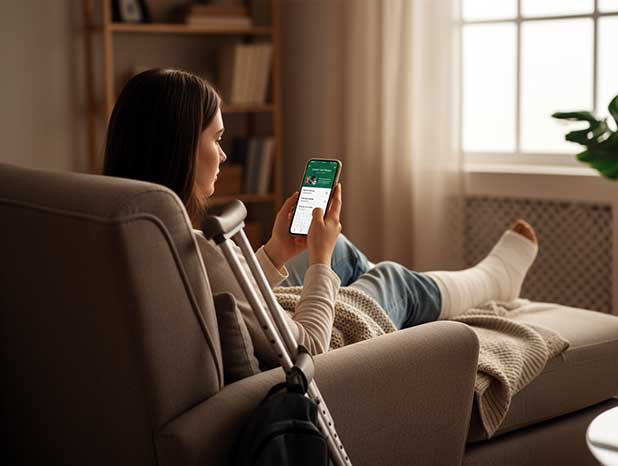
- Set up a landing zone at waist height so you cut crutch time and protect hands, shoulders, and your good leg.
Table of Contents
- Why crutches feel so exhausting
- Signs you are overdoing it
- How much total crutch time per day is typical
- The crutch day planner framework
- Build your plan (mini app)
- Sample non weight bearing day plan
- Micro breaks and upper body relief
- Make your home match your energy
- Mindset and expectations
- Simple daily checklist
- Common questions
- Safety note and disclaimer
Why crutch fatigue hits so hard (and feels so exhausting)
Three days into crutches, even a trip to the bathroom can leave you sweaty and shaking. It is not in your head-your body is suddenly using new muscles and burning more energy for basic movement. If your hands are flaring, start with our hand and wrist pain relief guide and consider underarm vs. forearm crutches if your hands or shoulders need a break.
Normally, walking shares the load across your legs, hips, and core. On crutches, your hands, shoulders, and wrists are lifting you while your good leg carries full weight on every hop. Your heart rate spikes and you get a mini upper body workout every time you leave the couch.
What works the hardest on crutches:
- Hands and wrists: gripping and pushing down on every step.
- Shoulders and upper back: stabilizing and lifting like tiny push-ups all day.
- Your good leg: carrying your full weight on each hop or step.
- Your core and balance system: staying on high alert to prevent tipping.
- Your cardiovascular system: pumping harder because crutching burns more calories than normal walking.
Stack all of that together and even short trips feel like a workout. That is why pacing matters.
Signs you are overdoing it on crutches
Your body will warn you when you are past your limit. Stop and rest if you notice any of these:
- Numbness, tingling, or burning in hands or armpits-often from leaning or gripping too hard.
- Good leg cramps or wobbles because it is working double time.
- Lightheadedness, dizziness, or breathlessness after short trips.
- Tight, locked shoulders or neck from overuse.
- Tripping or catching crutch tips because fatigue is making you sloppy.
- Feeling frustrated or overwhelmed after basic tasks.
When to call your doctor
Sharp pain, sudden swelling, lingering numbness, chest pain, or dizziness that scares you are medical issues-call your care team right away.
How much total crutch time per day is typical early on
These are common starting points—not prescriptions. Your surgeon or PT may set different limits.
- Week 1: often 20-40 minutes total on feet for the whole day, spread across many short trips.
- Week 2: often 30-60 minutes total, still in small bursts with lots of sitting.
- Weeks 3-4: often 45-90 minutes total if energy, pain, and balance allow.
- Week 5+: varies a lot; only increase if cleared and pain is low.
If your trips are 3-5 minutes and your max is 8-10 trips on a yellow or red day, that is roughly 30-50 minutes total on your feet—use the trip counter and fatigue colors to keep yourself in that ballpark.
Always defer to your medical team if they give you stricter limits.
The crutch day planner framework
This planner is built on one idea: you have a limited energy budget each day, so spend it wisely. Break the day into three habits:
- Short walking bursts: for many people, 2-5 minute trips are a helpful starting point in the first week or two.
- Planned rest windows: sit for at least 5-10 minutes after every trip so hands, shoulders, and your good leg reset.
- A daily energy budget: do the most important tasks early while you are fresh. When the budget is gone, you are done for the day.
Use a simple color system to match effort to how you feel:
- Green day: you slept well, pain is low, and you can do a bit more-without going wild.
- Yellow day: you are sore or tired; dial back to essentials and rest more.
- Red day: you are clearly overworked; make it a recovery day and ask for help.
How this changes for ankle, knee, or hip injuries
- Ankle or foot fractures: non-weight bearing is common early, so hands and shoulders do extra work while your good leg hops. Fatigue spikes fast; keep trips very short and sit immediately after.
- Knee ligament or meniscus repairs: partial or touch weight bearing often means awkward, uneven loading. Protect the repair by keeping steps small and stopping when form or balance slips.
- Hip surgery or hip fracture: balance can feel shaky and pain meds may fog energy. Shorter trips with longer rests help avoid stumbles; follow hip precautions from your surgeon or PT first.
Your personal crutch day planner tool
Answer five quick questions and get a personalized plan with pacing suggestions, stretch reminders, and a fatigue tracker you can use throughout the day.
Note
This is not medical advice. Use this tool as a starting point, then adjust based on what your doctor or physical therapist told you. Everyone's injury and recovery is different.
🟢 Green day
Energy decent, pain low. Do essentials plus one bonus task, still keep trips short and rest after each.
🟡 Yellow day
Feeling tired or sore. Stick to essentials, add longer rests, and trim total trips.
🔴 Red day
Clearly overworked. Keep trips to true needs only, ask for help, and make it a recovery day.
🩼 Build Your Crutch Day Plan
See an example crutch day plan (no input needed)
Want a quick idea before answering? Here is a tiny preview. Jump to the full sample day below for more.
Your Personalized Crutch Day Plan
Tap your energy level right now. This helps you track patterns and know when to dial back.
Current status: Not set
Suggested max: Set after you generate a plan
Track how many times you get up today. Awareness helps you pace better.
Real world use cases of this planner
Week 1, ankle fracture, living alone
Settings: Non weight bearing, Week 1, sedentary, arm pain 6-7, calf tightness 6.
Day shape: 3-4 minute trips, 8-10 min sits after each, 8-10 trips total. Prep water/snacks at waist height and lean on delivery for meals.
See the sample day plan and mirror it with the trip counter.
Week 3, ACL repair, back at a desk job
Settings: Partial weight bearing, Week 3-4, moderate fitness, arm pain 3-4, calf tightness 4.
Day shape: 5-7 minute trips, 5-8 min sits after each, 10-12 trips. Batch desk time, stand up hourly for short walks, keep calls seated.
Compare to the sample day plan and adjust blocks for your work hours.
Parent on crutches, caring for kids
Settings: Touch weight bearing, Week 2, fitness active, arm pain 4-5, calf tightness 5-6.
Day shape: 4-6 minute trips, 8-10 min sits after each, 10 trips. Park essentials in one room, ask for help with pickups, and cluster kid tasks together.
Use the sample day plan but build longer rest windows during kid downtime.
Privacy note: This tool uses localStorage to save your preferences and trip counts. Your data stays on your device and is never sent anywhere.
Sample crutch day planner for a non weight bearing day
Use this as a starting point and adjust for your home layout, injury, and energy. The point is to bake rest into every move.
| Time block | Activity | Notes |
|---|---|---|
| 7:00 AM | Wake up, first bathroom trip | Go slow. Sit back down on the bed for a minute after washing hands. |
| 7:15 AM | Get dressed, take meds | Sit to put on clothes. Keep everything within arm's reach. |
| 7:30 AM | Crutch to kitchen for breakfast | Keep it around 5 minutes if you can, especially early on. Use a backpack or crossbody bag. |
| 7:45 AM | Eat breakfast, rest | Sit 20-30 minutes. Shake out hands and stretch shoulders. |
| 8:30 AM | One important task | Pick one: work call, shower, or meds check-in. |
| 9:30 AM | Rest window | Lie down, elevate the injured leg, ice if prescribed. |
| 11:00 AM | Short trip for snack or bathroom | Quick in-and-out, then sit right back down. |
| 12:00 PM | Lunch | Eat seated. Rest at least 30 minutes afterward. |
| 1:00 PM | Midday rest or nap | Eyes closed counts. Healing happens while resting. |
| 3:00 PM | Bathroom, quick stretch | Move gently to avoid stiffness; keep it short. |
| 4:00 PM | Optional second task | Only if it is a green day. Skip on yellow or red days. |
| 6:00 PM | Dinner prep or delivery | Let someone bring food if possible. Save energy. |
| 6:30 PM | Eat dinner, rest | Stay seated 30 minutes. Home stretch. |
| 8:00 PM | Final bathroom trip, get ready for bed | Brush teeth sitting down if it helps. |
| 9:00 PM | In bed, elevated, resting | Review the day and adjust tomorrow's plan. |
Key takeaway
Notice how much sitting and resting is baked in. That is not laziness-it is how your body heals and keeps you safe on crutches.
Micro breaks and upper body relief
Even with pacing, hands, wrists, and shoulders get tight. Cycle these relief moves throughout the day and follow any specific instructions from your clinician.
Hand and wrist relief
- Hand shakes: arms at your sides, shake like flicking water for 10-15 seconds after each trip.
- Wrist circles: slow circles, 5 times each direction.
- Finger stretches: spread fingers wide, then make a gentle fist. Repeat 5 times.
Shoulder and upper back relief
- Shoulder rolls: roll backward in slow circles 5-10 times.
- Neck stretches: tilt ear to shoulder for 10 seconds, switch sides. No forcing.
- Chest opener: squeeze shoulder blades together gently for 5 seconds. Repeat 5 times.
Good leg relief
- Calf stretches: only with doctor approval; toes on a small step, heel gently lowered for 15 seconds.
- Ankle circles: seated, circle the ankle slowly 5 times each way.
- Leg elevation: prop the good leg whenever you sit to reduce swelling.
Important: If your medical team told you to avoid certain movements, follow their plan instead of this general list.
Night time pacing and “hit the wall” moments
Night time bathroom runs
- Keep a clear lit path: night lights, no cords or rugs, shoes on for grip.
- Go slow and short: treat it like a yellow/red trip—2-3 minutes max, then sit.
- Backups help: a bedside urinal, commode, or bottle can save you a dangerous trip.
If you suddenly hit your limit mid day
- Signs you are now “red”: shaky good leg, hand tingling that lingers, wobbly balance, dizziness, or brain fog.
- Do right now: sit immediately, elevate if advised, hydrate, and text/call for help if alone.
- Adjust the plan: cancel optional tasks, stretch trips farther apart, and restart tomorrow with fewer trips.
- Call your care team for any sharp pain, numbness that persists, chest pain, or shortness of breath.
Make your home match your energy
Small changes to your space can cut daily crutch time in half. Do not try to outwork fatigue-rearrange for fewer, shorter trips.
Keep essentials at waist height
Move chargers, meds, water, snacks, and remotes where you can reach them without bending or climbing.
Set up a landing zone
Pick one spot (couch, bed, or chair) as home base. Keep water, tissues, hand lotion, phone, pain meds, and a small trash bin within arm's reach.
Use rolling carts and crossbody bags
You cannot carry much while crutching. A rolling cart or snug crossbody bag keeps hands on the grips and cuts extra trips. See crutch life hacks for clever carry setups.
Rearrange for fewer steps
Sleep on the same floor as the bathroom if stairs are involved. Move toothbrushes, towels, and daily items closer to where you rest.
Ask for help with meals
Batch cooking, delivery, or friends dropping meals saves energy. Your job right now is to heal, not to prove you can cook on crutches.
Mental health and expectations
Crutches do not just hit your body-they mess with your head. Feeling weak or embarrassed is normal when basic tasks suddenly take everything.
Celebrate small wins
Making one fewer trip, resting after every move, or asking for help instead of pushing through pain are all real wins.
Lower your expectations
You are not lazy for resting. You are healing from an injury and adapting to a new way of moving. Let dishes sit. The goal is to recover safely.
Track your energy patterns
Log green, yellow, or red days plus how many trips you made. Patterns appear within a week and help you plan around PT sessions or busy mornings.
Connect with others
Online communities and friends who have been on crutches make a big difference. Feeling understood helps you stay patient while you heal.
Simple crutch day planner checklist
You can mirror this checklist inside the planner tool above—log your trips and mark whether today feels green, yellow, or red to keep your pacing honest.
Before you start your day
- Check in: green, yellow, or red day?
- Set up your landing zone with water, meds, phone, and snacks.
- Schedule the most important task for your highest-energy window.
- Wear comfortable clothes and confirm crutch fit.
During each trip
- Aim for ~5 minute trips at first if it feels safe for you.
- Stop if you feel lightheaded, shaky, or in pain.
- Weight goes through your hands, not your armpits.
- Carry items in a backpack or crossbody bag, not in your hands.
After each trip
- Sit immediately for at least 5-10 minutes.
- Shake out hands, roll shoulders, and elevate the injured leg if advised.
- Drink water-crutching dehydrates faster than you think.
Before bed
- Review your day and adjust tomorrow's plan.
- Do gentle hand, wrist, and shoulder stretches.
- Reset your landing zone for the morning.
- Sleep as much as you can. Healing happens during rest.
Crutch fatigue and pain: common questions
In the first week or two, many people find it helpful to keep each trip around 5 minutes or less. As you build strength, you can slowly increase to 10-15 minutes, but listen to your body. If your hands start to hurt, your shoulders get tight, or your good leg feels wobbly, stop and rest. Only your doctor or physical therapist can give personalized guidance for your situation.
Yes, hand pain is common early on because your hands and wrists are doing a job they were not designed for. Padded grips, frequent breaks, and a relaxed (not white-knuckled) grip help. Sharp pain, swelling, or numbness that does not fade are reasons to call your doctor.
Call your doctor for sharp or severe pain that does not improve with rest, numbness or tingling that lasts after you stop, swelling or warmth, pain or swelling in your good leg (especially the calf), chest pain, trouble breathing, dizziness, or fainting. Your medical team should guide next steps.
Your body is healing, and healing burns energy even at rest. Every crutch trip also spikes effort because your arms, core, and good leg are doing extra work while your balance system stays alert. Add in mental stress and it is normal to feel wiped out.
Endurance improves over time. Week one may leave you winded after a bathroom trip. By week three or four, most people notice smoother, less exhausting moves. Increase time in small steps and stop when form slips. If you are still struggling after a few weeks, ask your physical therapist to check fit and technique.
Safety note and disclaimer
Important
This article is for education and general information only. It is not medical advice. Every injury and recovery plan is unique. Follow the exact weight-bearing limits, rest instructions, and activity guidance your surgeon, doctor, or physical therapist provided.
If you experience pain, numbness, swelling, dizziness, or any other concerning symptom while using crutches, contact your healthcare provider immediately.