Table of Contents
- Detailed mechanics guide
- First steps when you are scared of stairs
- Why stairs trigger panic
- Safety first, before panic wins
- Know your stair situation before panic hits
- Memory rule: up with good, down with bad
- One-rail method (short version)
- Two-rail method (short version)
- No-rail stairs: stop and rethink
- Calm-down strategies
- Practice plan (2 steps)
- How a spotter helps
- Common mistakes
- Mini stairs cheat sheet
- Common questions
- Safety note
First steps when you are scared of stairs on crutches
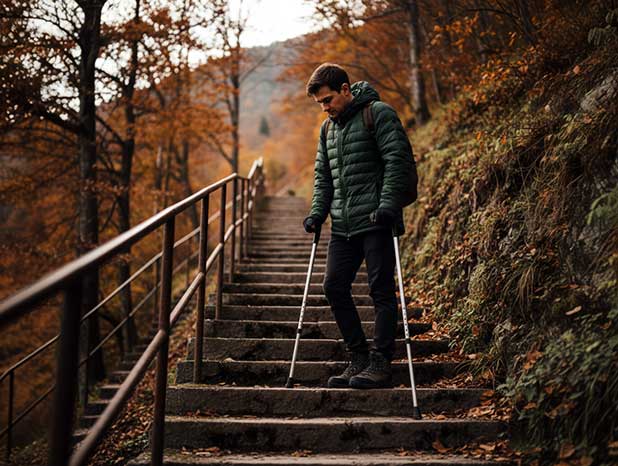
The first time I looked down a staircase on crutches, my brain said absolutely not. My apartment was on the second floor. There was no elevator. And suddenly those twelve steps felt like the edge of a cliff.
If you are standing at the bottom or top of a staircase right now, heart pounding with a fear of stairs on crutches or feeling scared to use stairs on crutches, you are not alone. Stairs on crutches are genuinely scary, especially in the first few days. This guide will not make you an Olympic stair climber overnight, but it will walk you through the most common setups, give you simple step sequences you can actually remember, and help you feel a little less panicked about the whole thing.
This page is about fear and confidence. For the full technique breakdown with step photos, use the main stairs guide here.
On your first day home after surgery, the only stair goal might be one safe, supervised trip—not mastering the whole staircase alone.
This is not about perfect form. It is about getting up or down safely, one step at a time, without freaking out.
If you are panicking right now
- No rail and no spotter? Do not attempt the stairs.
- Dizzy or drugged? Sit back down and wait.
- Must use the stairs today? Practice on two safe steps first with someone spotting you.
- Stairs are wet, icy, or broken? Choose another route.
When not to use stairs at all
- No clearance from your doctor or PT
- Heavy pain meds on board and feeling loopy
- Wet, icy, broken, or cluttered stairs
- No rail and no spotter
If any of these are true, wait, get help, or choose another route. This article does not apply yet.
Why Stairs Feel So Scary On Crutches
Stairs are already one of the riskiest places in any building, even when you have two working legs. Add crutches and a non weight bearing order from your doctor, and your brain suddenly has to manage about six different things at once while you are also trying not to look down and imagine yourself tumbling. Feeling terrified of stairs on crutches or even a phobia of stairs after surgery is common, and it is not an overreaction.
Here is what your brain is juggling on every single step:
- Where to put the crutch tip so it does not slip
- Which leg is the good one, which leg is injured
- Whether to grab the handrail, and with which hand
- How to balance on one foot in midair for a second
- Whether the person behind you is getting impatient
- The fact that falling from this height would really, really hurt
That is a lot. And it is why even people who feel pretty steady on flat ground can freeze completely at the top of a flight of stairs. Your fear is not irrational. It is your brain doing its job and keeping you alive.
Safety First, Before You Even Take A Step
Before we get into technique, let's talk about the basics that can make or break your stair safety.
Shoes matter. Wear shoes with actual grip on the bottom. Not socks, not slippers, not those hospital non slip socks that have been through the wash five times and lost all their traction. Real shoes with rubber soles.
Check your crutch tips. Look at the rubber tips on the bottom of your crutches. Are they worn smooth? Are they wet from rain or snow? If yes to either, do not use stairs until you have dried them off or replaced them. A slipping crutch tip on a stair edge is how people get hurt. For winter grip, see our winter crutch accessories.
Lighting and clutter. Make sure you can see every step clearly. If the stairwell is dim, turn on a light or use your phone flashlight. Move any boxes, shoes, or clutter off the steps. You need a clear path and you need to see where your crutch is landing.
Follow your orders. If your doctor or physical therapist told you that you are not ready for stairs yet, or that you need someone with you, listen to them. This guide gives you general techniques, but your medical team knows your specific injury and your specific body. Their instructions beat anything you read online, including this.
Use trusted fall-risk guidance. National resources like the CDC fall prevention tips can help you audit your space for hazards.
Safety checks before you start
- Shoes with grip: Wear real rubber-soled shoes, not socks or slippers.
- Dry, intact tips: Inspect crutch tips and dry or replace if worn smooth.
- Clear sightlines: Turn on lights and clear boxes or shoes off the steps.
- Provider clearance: Follow the exact stair instructions your medical team gave you.
Know Your Stair Situation
Not all staircases are created equal, and the technique you use will depend a lot on what kind of handrail setup you are dealing with. Here are the three most common scenarios:
Stairs with one handrail. This is the most common setup in homes and apartment buildings. The rail is usually on the right side as you go up. You will use the rail with one hand and manage your crutches with the other, or hold both crutches in one hand.
Stairs with handrails on both sides. Some staircases, especially in public buildings, have rails on the left and right. This can actually make things easier because you can use the rails like very sturdy crutches and leave your actual crutches at the top or bottom.
Stairs with no handrail at all. This is the hardest and riskiest situation. If you are facing a flight of stairs with no rail and you are non weight bearing, you need to seriously consider whether there is any other option, including asking for help, going a different route, or waiting until someone can spot you.
Stairs with carpet. Plush or worn carpet can hide edges and change grip. See the carpet-specific techniques in our carpeted stairs guide.
Steep, narrow, or spiral stairs. Treat these as high risk: ask for help, use another route, or avoid entirely until your provider clears a safe method.
Basic Rule of Thumb: Up With The Good, Down With The Bad
There is a classic memory trick for stairs on crutches, and it goes like this: Up with the good, down with the bad.
Here is what that means in plain English:
Going up stairs: Your strong leg, the one that is not injured, leads the way. You push off with your crutches and step up with your good leg first. Then you bring the crutches and injured leg up to meet it.
Going down stairs: Your crutches and your injured leg go first. You lower the crutches down to the next step, then lower your injured leg, then step down with your good leg last.
Why does this work? Because your good leg is the one doing the heavy lifting. When you go up, you need that strong leg to push your body weight upward. When you go down, your good leg is the anchor that controls your descent at the end.
This is a general pattern, and it works for a lot of people. But it is not a universal law. Some people have different instructions from their physical therapist based on their specific injury, and that is fine. If your PT told you something different, do what they said.
Memory trick
Up with the good, down with the bad. Repeat it before every flight so the sequence is automatic when nerves kick in.
How to Get Over Fear of Stairs on Crutches
Fear is information, not failure. Treat it like a signal to slow down, script your moves, and make the staircase less risky.
- Practice on two steps. Run ten slow reps on a low step or porch until the rhythm feels automatic.
- Rehearse the script out loud. “Rail, crutch, good leg” going up; “crutches, bad leg, good leg” going down.
- Control the environment. Lights on, clutter gone, dry tips, solid rail. If any of those are missing, wait for help.
- Time your climbs. Go when you are rested and pain is managed. Fatigue and anxiety multiply slips.
- Spotter over speed. Ask someone to trail you the first few attempts; confidence rises fast when you know a hand is there.
The goal is to shrink the unknowns: fewer steps, better lighting, clear scripts, and a helper nearby the first times. Confidence follows repetition, even if you are scared of stairs after ankle surgery or feeling anxiety on stairs with crutches.
How your weight bearing status changes stair options
- Non weight bearing: Only attempt stairs if your provider clears it, often with a spotter. Assume hopping patterns and short practice runs first.
- Toe-touch weight bearing: Similar technique to non weight bearing, but light toe contact can add stability. Still follow the approved sequence.
- Partial weight bearing: More options, but use the exact limits your PT gave you. Add weight gradually and keep a rail or helper.
This guide assumes non weight bearing or toe-touch unless stated otherwise. If your instructions differ, follow your provider.
How To Use Crutches On Stairs With One Handrail
This is the big one. Most people reading this are dealing with a staircase that has one rail on one side. Here is how to handle it, step by step.
Going Up: One Rail And Crutches
Let's say the handrail is on your right as you go up. Keep it simple:
- Rail in the right hand, both crutches in the left.
- Push, then good leg steps up first.
- Bring crutches and injured leg up to meet it.
The rhythm is: rail and crutches push, good leg up, bad leg and crutches follow. Need the full visual? See the detailed sequence in the core stairs guide.
Going Down: One Rail And Crutches
Going down is scarier because you are lowering into space. Same setup, rail on the right as you go down:
- Rail in the right hand, crutches in the left.
- Crutches and injured leg go to the lower step first.
- Good leg steps down last.
The rhythm is: crutches and bad leg down first, good leg follows. For full diagrams, see the core stairs guide.
How To Use Crutches On Stairs With Two Handrails
If you are lucky enough to have rails on both sides, you have an option that can feel more stable for some people: ditch the crutches temporarily and use the rails as if they are a very wide pair of crutches.
Going Up With Two Rails
- Set crutches aside; grab both rails.
- Push into both rails; good leg steps up first.
- Bring injured leg up while arms take the load.
Going Down With Two Rails
- Rails in both hands, crutches waiting.
- Lower injured leg to the next step first.
- Good leg follows while arms control the descent.
Some people feel way more secure with two rails. Others prefer to keep their crutches with them. There is no wrong answer, as long as you are stable and following your weight bearing restrictions.
Practice on two safe steps before tackling a full flight
- Pick a low step or porch with good lighting and a solid rail.
- Have a spotter stand close behind or beside you.
- Practice 3–5 slow reps up and down using your cleared method.
- Stop before fatigue or panic hits; rest and repeat later.
This first assignment builds rhythm without the pressure of a full staircase.
How a spotter can actually help you on stairs
- Stand close but not touching. Behind you for descents, just off to the side for ascents.
- Keep one hand free. Ready to steady your upper back or hip if you wobble—never pulling arms or crutches.
- Use clear cues. Agree on simple words like “pause” or “step” before you start.
- Never pull or push. Pushing throws balance off; instead, spot and guide calmly.
A spotter’s job is to be there if you slip, not to steer you. If they are unsure, walk through the sequence on two practice steps first.
Stairs With No Handrail: When To Stop And Rethink
Let's be real. Stairs with no handrail on crutches, especially if you are non weight bearing, are a bad situation. This is not the time to be a hero.
If you have any other option, take it. Can you ask a neighbor for help? Can you call a friend to spot you? Is there an elevator in another part of the building, even if it is a longer walk? Is there a ramp somewhere, anywhere?
If you absolutely must go up or down a flight of stairs with no rail and no help, some people will sit down on the steps and bump up or down on their butt, moving the crutches along with them. This is slow and not exactly dignified, but it is lower to the ground and harder to fall from. However, this is not something I can walk you through in detail here, because it really depends on your specific injury, your upper body strength, and whether your doctor has cleared you to put that kind of pressure on your body.
Do not attempt stairs with no rail and no training unless you have explicit instructions from your physical therapist. This is one of those situations where the risk is just too high to wing it based on an article.
If you are in a building with stairs and no rail and no elevator, talk to your landlord or building management. In many places they are required to provide reasonable accommodations. You should not have to risk a fall every time you need to get home.
High-risk stairs
No rail and no training? Wait for help, find another route, or ask for a temporary rail. Your recovery is not worth a fall.
Mental Strategies: Staying Calm On Each Step
Okay, let's talk about the mental side, because the fear is real and it can freeze you in place.
It is completely normal for your hands to shake on the handrail. It is normal for your heart to race before you even start. It is normal to stand at the top step for thirty seconds psyching yourself up. You are not being dramatic. You are being cautious, and that is smart.
Here are a few things that help:
Name each action out loud. Say it as you do it. "Rail. Crutch. Good leg up. Bad leg up." It sounds silly, but giving your brain a simple script to follow cuts through some of the panic noise.
Look at the step you are moving to, not the bottom of the staircase. If you stare down at the ground floor ten steps below, your brain will panic. Look at the single next step. That is all you have to do right now. Just one.
Breathe in at the top of each step, breathe out as you move. It gives you a rhythm and stops you from holding your breath, which makes everything feel more tense.
It is okay to stop halfway. If you need to pause on a landing or even just stand on one step and reset, do it. You do not get bonus points for speed.
And if you get to the bottom or the top and you feel like crying or laughing or both, that is fine too. Stairs on crutches are hard. You did it.
Calm-down cues
Name each action, stare at the next step only, and pair every move with a breath. These three cues keep panic from hijacking your balance.
If you freeze completely
Stay where you are, grip the rail, look at the next step (not the bottom), call out to your spotter, and breathe: in for 4, hold for 4, out for 6.
Common Mistakes On Stairs With Crutches
Here are some things that seem like good ideas in the moment but are actually a recipe for disaster:
- Rushing because people are behind you. If someone is waiting, let them go around you or just accept that they will wait. Your safety is more important than their schedule.
- Carrying a bag, a phone, a coffee cup, or anything else in your hand. You need both hands for the crutches and rail. Put your phone in your pocket. Leave the coffee upstairs. Ask someone to carry your bag (or use the setups in how to carry things on crutches).
- Letting a friend pull or push you while you are on the steps. This throws off your balance and timing. If someone wants to help, have them walk behind you as a spotter, ready to catch you if you wobble, but not touching you unless you start to fall.
- Wearing socks or slippery shoes because you are only going up one flight. One flight is all it takes. Wear the grippy shoes every time.
- Looking at your phone or getting distracted mid staircase. Stairs require your full attention. Texts can wait.
- Trying stairs for the first time when you are exhausted or in a lot of pain. If you have a choice, practice stair technique when you are rested and your pain meds are working. Do not wait until you are wiped out at the end of the day and have no choice but to tackle the stairs to get to bed.
Quick Reference: Mini Stairs Cheat Sheet
Screenshot this on your phone or print it and tape it near your stairs. Here is the shortest possible version:
Going up with one rail:
- Rail in one hand, both crutches in the other
- Push on rail and crutches
- Good leg steps up first
- Crutches and bad leg follow
Going down with one rail:
- Rail in one hand, both crutches in the other
- Crutches and bad leg go down to next step first
- Good leg steps down last
Going up or down with two rails:
- Set crutches aside, use both rails like wide crutches
- Up: good leg first. Down: bad leg first
When to stop and ask for help:
- No handrail at all
- You feel too tired or in too much pain to focus
- The stairs are wet, icy, or cluttered
- You have not practiced this yet and you are alone
| Scenario | Sequence |
|---|---|
| Going up with one rail | Rail in one hand, both crutches in the other. Push, good leg steps up first, crutches and bad leg follow. |
| Going down with one rail | Rail in one hand, both crutches in the other. Crutches and bad leg go down first, good leg steps down last. |
| Two handrails | Set crutches aside, use both rails like wide crutches. Up: good leg first. Down: bad leg first. |
| When to stop and ask for help | No rail, too tired or in pain, wet/icy/cluttered steps, or you have not practiced and are alone. |
Need the full sequences and visuals? Visit the main stairs mechanics guide at how to use crutches on stairs.
Stop and call your provider if you notice
- Sudden sharp pain in the injured leg or calf
- New numbness or tingling that does not fade
- Chest pain, shortness of breath, or feeling faint
Stop the stairs, sit safely if you can, and contact your surgeon or PT before continuing.
Crutches On Stairs: Common Questions
Expand a question to hear the full answer about using crutches on stairs.
Yes, that is the most common technique when you have a handrail on one side. You hold the rail with one hand for stability and hold both crutches together in the other hand. It feels awkward the first few times, but most people get used to it quickly. Make sure you have a solid grip on both crutch handles so they do not slip apart.
For some people, sitting and scooting up or down the stairs one step at a time can feel safer, especially if there is no handrail or if you are very early in your recovery and do not feel stable yet. However, you should only do this if your doctor or physical therapist has said it is okay for your specific injury. Some injuries or surgeries do not allow you to sit and push like that because of the pressure it puts on your body. Ask your medical team first.
If you are feeling exhausted, shaky, or in a lot of pain, even one flight of stairs might be too many right now. Fatigue kills your balance and focus, and that is when falls happen. If you have the option to rest, take an elevator, or ask someone to help you, do that. If you absolutely have to do the stairs, take breaks on every landing and do not rush. Only you know your body, but if your gut is saying you are too tired, listen to it. Your medical team can also give you guidance on how much activity is safe as you are recovering.
If you feel yourself wobbling, stop moving immediately. Freeze and grip the handrail as tight as you can. Do not try to catch yourself by putting weight on your injured leg unless you have been told partial weight bearing is allowed. If you have a spotter with you, call out to them. Take a few breaths, reset your grip on the rail and crutches, and then continue slowly. If you feel like you cannot continue safely, sit down on the step if you can and call for help. It is better to stop than to fall.
Yes, and you should if possible. If you are still in the hospital or at a rehab facility, ask your physical therapist to practice a few stairs with you before you go home. If you are already home, try to practice at a time of day when you are rested, your pain is controlled, and ideally someone else is home to spot you. Start with just two or three steps if you have a small set of stairs, like a porch. Get the rhythm down before you tackle a full flight.
Start with two safe steps, a spotter, and a simple script: rail and crutches down, bad leg down, good leg last. Practice a few reps when rested, use the breathing pattern (in for 4, hold 4, out 6), and move to a full flight only when your provider clears it. If fear stays high, pause and use the main stairs guide for visuals.
Safety Note And Disclaimer
This article is for educational purposes and general information only. It is not medical advice, and it is not a substitute for the instructions you receive from your doctor, surgeon, physical therapist, or any other healthcare provider.
Every injury is different. Every person's body is different. What works safely for one person on crutches may not be safe for you, depending on your specific surgery, your weight bearing status, your balance, and a dozen other factors that only your medical team can assess.
Always follow the instructions from your own healthcare providers, especially when it comes to using stairs. If they told you not to attempt stairs yet, do not attempt stairs. If they gave you a specific technique that is different from what is described here, use their technique.
If you are unsure whether you are ready for stairs, or if you feel unsafe attempting them, contact your medical team and ask for guidance or additional training. Do not risk a fall because you read something online. Stay safe.
If you are a PT, OT, or nurse teaching someone stairs with crutches, adapt these scripts to match your protocol.
Ready to make stairs feel less scary?
Test your rail, inspect crutch tips, clear clutter, and practice the sequence on two safe steps before your next staircase.
Explore more How-To guidesNext steps if stairs are your biggest fear right now
- Practice on two safe steps with this cheat sheet open.
- Ask your PT to watch one flight and adjust your technique.
- Set up shoes and crutch tips so every stair trip feels predictable.